
Transmission Components#
This page describes how the electricity transmission network is represented in the model, including AC lines, DC interconnectors, offshore bus mapping, and transmission availability.
Overview#
The transmission network defines how power flows between buses in the model. It spans the internal GB meshed transmission system, the DC interconnectors linking GB to continental Europe and Ireland, and the AC and DC lines connecting European countries to one another.
The network comprises two layers:
AC lines: The internal GB high-voltage transmission grid, built from the OpenStreetMap (OSM) pre-built network and clustered to model regions
DC interconnectors: Cross-border HVDC links connecting GB to neighbouring countries, sized by FES scenario and year
Before clustering, offshore wind farm stub buses in the OSM network are remapped to their electrically connected onshore regional bus — see Data cleaning for details.
Transmission availability is accounted for through monthly unavailability fractions derived from NESO operational reports, applied separately to the intra-GB network and cross-border interconnectors.
Data Sources#
The figure below gives a high-level view of the transmission pipeline:
![digraph {
rankdir=LR;
node [shape=box, style=filled];
osm [label="OSM pre-built\nnetwork", fillcolor="#B3D9FF"];
tyndp [label="ENTSO-E TYNDP\n(PyPSA-Eur)", fillcolor="#B3D9FF"];
neso_pdf [label="NESO transmission\navailability reports\n(PDF)", fillcolor="#B3D9FF"];
fes_plan [label="FES interconnector\ncommissioning plan\n(config)", fillcolor="#B3D9FF"];
regions [label="Merged region\nshapes", fillcolor="#FFFACD"];
busmap [label="Offshore busmap\n(stub → region)", fillcolor="#FFFACD"];
intercon [label="interconnectors_p_nom.csv\n(MW per year)", fillcolor="#FFFACD"];
avail_intra [label="intra_gb transmission\navailability (monthly)", fillcolor="#FFFACD"];
avail_inter [label="inter_gb transmission\navailability (monthly)", fillcolor="#FFFACD"];
network [label="PyPSA Network\n(Line, Link)", fillcolor="#90EE90", shape=ellipse];
osm -> busmap;
regions -> busmap;
osm -> network [label="AC lines\n(clustered)"];
tyndp -> network [label="intra-EU DC links"];
busmap -> network [label="offshore bus\nmapping"];
fes_plan -> intercon;
regions -> intercon;
intercon -> network [label="GB DC links\n(p_nom per year)"];
neso_pdf -> avail_intra;
neso_pdf -> avail_inter;
avail_intra -> network [label="line s_nom\nscaling"];
avail_inter -> network [label="link p_nom\nscaling"];
}](../_images/graphviz-338697ec5dbebfaddd2d1820cb58b1a4786a3dd1.png)
OSM Pre-built Network — AC Grid Topology#
The internal GB transmission grid topology is read from a custom version of the OpenStreetMap (OSM) pre-built network maintained by the PyPSA-Eur pipeline. The custom version extends the standard OSM extract to include voltage levels (132 kV, 275 kV, 400 kV) that are particularly relevant to the GB grid.
The network is configured via electricity.base_network: osm and the specific OSM archive version is pinned under data.osm.
ENTSO-E TYNDP — Intra-EU DC Links#
DC links between European countries are sourced from the ENTSO-E Ten-Year Network Development Plan (TYNDP) as processed by the base PyPSA-Eur workflow (build_tyndp_network rule).
These links enter the model as part of the clustered base network and are not modified by any GB-specific rules.
FES / Config — GB Cross-border Interconnector Commissioning Plan#
GB cross-border DC interconnector capacities and their commissioning years are defined entirely in the configuration file under interconnectors.
Each interconnector entry specifies:
Name: project identifier
Neighbour: country it connects to (converted to ISO2 country code for the PyPSA bus)
Capacity (MW): nominal power transfer capacity
TYNDP project ID and years: cross-reference to the ENTSO-E Ten-Year Network Development Plan for traceability
Lat/lon: approximate location of the GB connection point, used to assign the interconnector to the nearest model region
The interconnectors.plan section maps each FES scenario to a list of active interconnector projects by year, reflecting that different FES pathways assume different build-out of cross-border capacity.
Since the FES workbook does not detail which projects it has chosen to reach its optimal GB interconnector capacities, we have defined this list based on our best understanding of the available projects.
See our interconnector GitHub issue for more details.
NESO Transmission Availability Reports — Line Availability#
Monthly transmission unavailability fractions are extracted from the NESO operational transmission availability PDF reports, covering years configured in transmission_availability.years (default 2020–2024).
Reports include:
Intra-GB: Planned and unplanned unavailability (as a percentage) for each of the three GB Transmission Owner (TO) zones — NGET, SPT, and SHETL
Cross-border (interconnectors): Monthly unavailability percentage for each active interconnector project
These percentages are averaged over the configured year range to produce a stable monthly availability profile that is then applied as a p_nom or s_nom scaling factor for the simulated year.
System Components#
The table below lists the key PyPSA attributes for both transmission component types.
AC lines (n.lines) represent the internal GB meshed grid, clustered from the OSM pre-built network.
GB cross-border DC interconnectors (n.links, carrier = "DC") connect GB regional buses to neighbouring country buses and are sized by FES scenario and year.
Intra-EU DC links (also n.links) enter the model unchanged from the base PyPSA-Eur workflow via the ENTSO-E TYNDP and are not listed here.
Component |
Attribute |
Static / Dynamic |
Source |
Notes |
|---|---|---|---|---|
|
|
Static |
OSM + clustering |
Regional AC buses at each end; assigned during the PyPSA-Eur clustering step |
|
|
Static |
OSM |
Thermal rating (MVA) before availability scaling; derived from OSM voltage and line type |
|
|
Static |
OSM |
Series reactance and resistance (p.u.) from OSM line type and length; used in power-flow calculations |
|
|
Static |
OSM |
Number of parallel circuits; aggregated during clustering |
|
|
Static |
OSM |
Standard line type string (e.g. |
|
|
Static |
Default ( |
Capacity is fixed; the model does not invest in new AC lines |
|
|
Dynamic (hourly) |
Workflow (NESO PDFs) — not yet applied |
Hourly availability series derived by random-sampling the monthly TO-zone unavailability fraction with a fixed seed per zone. Currently processed but not applied to line ratings; the intent is to apply TO-zone availability to boundary transfer capabilities rather than individual line |
|
|
Static |
Workflow (config + regions) |
|
|
|
Static |
Workflow |
Set to |
|
|
Static (per model year) |
Workflow (FES config plan) |
One-directional nameplate transfer capacity (MW); scenario- and year-dependent. Projects are accumulated forward in time so a commissioned link retains its capacity in all later years |
|
|
Static |
Workflow ( |
Set to |
|
|
Static |
Default ( |
Capacity is fixed to the FES plan value; no investment in additional interconnector capacity |
|
|
Static |
Default ( |
No transmission losses modelled |
|
|
Dynamic (monthly) |
Workflow (NESO PDFs) |
Monthly availability fraction; a single value shared across all interconnectors per month, averaged over all projects and report years (see Transmission Availability) |
Configuration#
Example interconnector option entry (one entry per project under interconnectors.options):
  options:
  - name: Nemo
    neighbour: Belgium
    capacity_mw: 1000
    tyndp:
      id: 74
      year: [2016, 2018]
    lat: 51.31128166242589
    lon: 1.3452723677851797
Interconnector commissioning plan (maps FES scenarios to project lists by year):
  plan:
    HT:
      2021: [BritNed, East-West, IFA, IFA2, NS Link (NSL), Nemo] # existing
      2022: [Moyle, Greenlink (Greenwire), ElecLink] # existing
      2024: [Viking Link] # existing
      2028: [Aminth] # Could also be Cronos, NeuConnect, Tarchon
      2030: [MARES]
      2031: [Kulizumboo, SENECA, NeuConnect, Nautilus] # NeuConnect could also be Aminth, Cronos, Tarchon
      2032: [Cronos] # could also be Aminth, NeuConnect, Tarchon
      2033: [FAB Link, Gridlink, LirIC]
      2034: [Continental Link]
      2036: [NorthConnect]
    EE:
      2021: [BritNed, East-West, IFA, IFA2, NS Link (NSL), Nemo] # existing
      2022: [Moyle, Greenlink (Greenwire), ElecLink] # existing
      2024: [Viking Link] # existing
      2028: [Aminth] # Could also be Cronos, NeuConnect, Tarchon
      2032: [FAB Link, Gridlink, NeuConnect] # extra +150MW than expected; NeuConnect could also be Aminth, Cronos, Tarchon
      2033: [MARES]
      2034: [Cronos] # Could also be Aminth, NeuConnect, Tarchon
      2035: [LirIC]
      2036: [SENECA]
      2037: [Continental Link]
    CF:
      2021: [BritNed, East-West, IFA, IFA2, NS Link (NSL), Nemo] # existing
      2022: [Moyle, Greenlink (Greenwire), ElecLink] # existing
      2024: [Viking Link] # existing
      2030: [Aminth] # Could also be Cronos, NeuConnect, Tarchon
      2034: [FAB Link] # Could also be Gridlink, SENECA
      2035: [NeuConnect] # could also be Aminth, Cronos, Tarchon
      2036: [Cronos] # Could also be Aminth, NeuConnect, Tarchon
    HE:
      2021: [BritNed, East-West, IFA, IFA2, NS Link (NSL), Nemo] # existing
      2022: [Moyle, Greenlink (Greenwire), ElecLink] # existing
      2024: [Viking Link] # existing
      2029: [Aminth] # Could also be Cronos, NeuConnect, Tarchon
      2033: [NeuConnect, FAB Link] # NeuConnect could also be Aminth, Cronos, Tarchon; FAB could also be Gridlink, SENECA
      2034: [Cronos] # Could also be Aminth, NeuConnect, Tarchon
      2035: [MARES]
Transmission availability data configuration:
transmission_availability:
  years: [2020, 2021, 2022, 2023, 2024]
  intra_gb:
    zones:
    - NGET
    - SPTL
    - SHETL
    sample_hourly: true

  inter_gb:
    zones:
    - interconnectors
    sample_hourly: false

  random_seeds:
    NGET: 11
    SPTL: 22
    SHETL: 33
    interconnectors: 44
Implementation Notes#
Data Processing Workflow#
The transmission system is built through a pipeline implemented in rules/gb-model/transmission.smk:
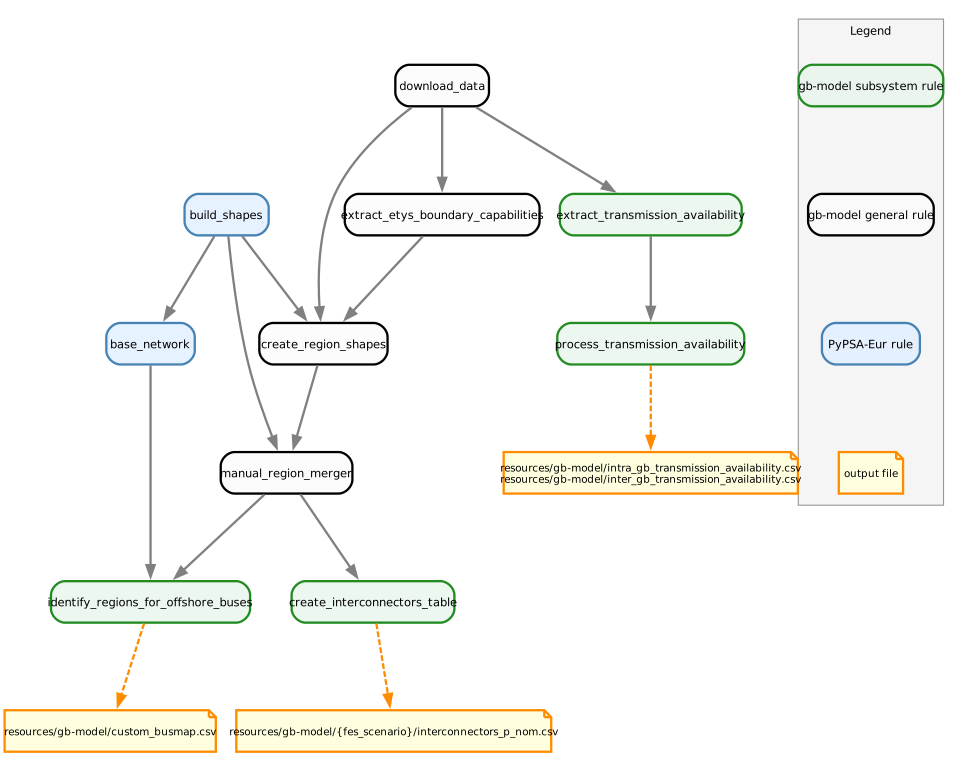
Note
The graph above was generated using:
pixi run filtered_rulegraph \
"resources/GB/gb-model/HT/interconnectors_p_nom.csv \
resources/GB/gb-model/intra_gb_transmission_availability.csv \
resources/GB/gb-model/inter_gb_transmission_availability.csv \
resources/GB/gb-model/custom_busmap.csv \
-w fes_scenario -w year \
-f rules/gb-model/transmission.smk \
-s 10,8" \
"doc/gb-model/img/transmission_workflow.svg"
The filtered_rulegraph task allows us to trim the full DAG to transmission-related rules only.
Extract availability (
extract_transmission_availability): Parses each NESO PDF report usingpdfplumber, extracting monthly unavailability tables for each TO zone and each interconnector projectProcess availability (
process_transmission_availability): Averages monthly unavailability across report years; for intra-GB zones, converts means to hourly0/1series by random sampling (reproducible via fixed seeds); for interconnectors, retains the monthly mean directlyInterconnector table (
create_interconnectors_table): Reads theinterconnectors.planfor the active FES scenario, accumulates capacity year-by-year, assigns each project to a GB model region using lat/lon point-in-polygon matching, computes line geometry (shortest path to neighbour country region), and outputs a per-yearp_nomCSVOffshore busmap (
identify_regions_for_offshore_buses): Traverses the OSM base network graph to identify offshore stub buses and maps them to their onshore regional bus; iterates until all multi-hop offshore chains are resolved
Key Assumptions#
Uniform zone availability: Intra-GB availability is applied at the TO zone level (NGET, SPTL, SHETL); individual line ratings within a zone are not differentiated
Interconnector availability: A single aggregate monthly fraction is used for all interconnectors, averaged over all projects and report years
Reproducible random sampling: Hourly availability realisation uses fixed random seeds per zone to ensure model results are reproducible across runs
Cumulative commissioning: Interconnector capacities are accumulated forward in time — a project appearing in any year’s plan remains active for all later years
Country scope filtering: Interconnectors to countries not in the
countrieslist are excluded; the model logs excluded projects at INFO levelNo new intra-GB lines: No additional AC transmission lines are assumed in future years; only the existing OSM topology is used. This is acceptable because the model constrains intra-GB power flows via boundary transfer capabilities rather than individual line ratings
Interconnector onshoring locations: The lat/lon of each interconnector’s GB connection point is based on a best-guess interpretation of substation names in public project documentation
Interconnector capacity plan: The mapping of FES scenarios to specific projects and commissioning years is a best-guess derived by comparing cumulative interconnector capacities against the FES headline figures — see our interconnector GitHub issue for details
Offshore Bus Mapping#
Offshore wind farms in the OSM network appear as stub buses outside the onshore regional boundaries. Without correction, network clustering can assign these stubs to the geographically nearest region, which may differ from the region they are electrically connected to — inadvertently creating spurious cross-region transmission lines.
The identify_regions_for_offshore_buses rule resolves each offshore stub to its true onshore connection point and writes the result to resources/gb-model/custom_busmap.csv, which is consumed by the PyPSA-Eur clustering step.
See also
Data cleaning — detailed description of the offshore stub problem, the mapping algorithm, and illustrative figures.
Transmission Availability#
Monthly availability fractions are derived separately for intra-GB lines and cross-border interconnectors.
Intra-GB (NGET, SPTL, SHETL):
Zone-level unavailability fractions are averaged over the configured report years.
The monthly mean is converted to an hourly 0/1 availability series by random sampling: for each month, a fraction of hours equal to the mean unavailability is drawn at random (using a fixed seed per zone for reproducibility) and marked as unavailable.
This series is currently processed but not applied to individual line ratings; the intended use is to reduce boundary transfer capabilities rather than individual line s_nom values, consistent with how the model constrains intra-GB flows via boundary MW limits.
Cross-border interconnectors:
Unavailability is averaged across all projects and report years to produce a single monthly mean fraction (sample_hourly: false), applied directly as a p_nom_pu scalar rather than sampled hourly.
See also
Related Documentation:
Dispatch and Redispatch Modelling - Network constraints and redispatch using transmission capacity
Generation Components - Generation assets connected to the same AC buses
Configuration - Full configuration reference
External Resources:
OpenStreetMap / PyPSA-Eur OSM network - Base grid topology
OSM pre-built network dataset (Zenodo) - gb-dispatch-model custom OSM archive (version 2026-02-20)
NESO transmission availability reports - Source of intra-GB and interconnector availability data
ENTSO-E TYNDP - Cross-border interconnector project reference