
Baseline demand & demand-side response (DSR)#
Overview#
The GB dispatch model incorporates demand-side response (DSR) capabilities across multiple demand sectors to provide flexibility in the electricity system. DSR allows for the shifting of electricity consumption from peak to off-peak periods, helping to balance supply and demand while reducing the need for additional generation capacity.
Demand Sectors#
The model includes the following demand sectors with DSR capabilities:
Baseline Electricity (Residential) - Residential electricity demand excluding heat pumps
Baseline Electricity (I&C) - Industrial and Commercial electricity demand
Residential Heat - Electricity demand for residential heating systems
I&C Heat - Electricity demand for industrial and commercial heating systems
EV Charging - Electric vehicle charging demand
Additional Demand - Other electricity demand not captured in the above categories (e.g., direct transmission demand, T&D losses)
Model Representation#
The DSR implementation for each demand type (residential, I&C, EV and heat) follows this structure:
![digraph Flow {
rankdir=LR; // Left to Right
node [shape=box, style=filled];
AC_bus [label="AC Bus", fillcolor="#B3D9FF", shape=ellipse, width=2, height=1.5, fixedsize=true];
Sector_bus [label="Sector Bus", fillcolor="#FFD1DC", shape=ellipse, width=1.8, height=1.2, fixedsize=true];
Sector_DSR_bus [label="Sector DSR Bus", fillcolor="#FFD1DC", shape=ellipse, width=1.8, height=1.2, fixedsize=true];
heat_load [label="Sector Load", fillcolor="#FFDAB9"];
sector_dsr_store [label="Sector DSR Store", fillcolor="#FFFACD"];
AC_bus -> Sector_bus [label="unmanaged load link"];
Sector_bus -> heat_load;
Sector_bus -> Sector_DSR_bus [label="charge"];
Sector_DSR_bus -> Sector_bus [label="discharge"];
Sector_DSR_bus -> sector_dsr_store [dir=both];
}](../_images/graphviz-ba60c0fa733a0ad178066db810c2ff073a7a3b9c.png)
“Sector” refers to the specific demand sector being modeled (e.g., residential, I&C, EV, heat or hydrogen). Whilst the general structure is consistent across demand types, some extra components are added for specific sectors which can be found in the corresponding documentation sections (see Electric Vehicle Subsystem, Heat System, Hydrogen Subsystem).
Data Sources#
Great Britain data#
Demand and flexibility data are sourced from the Future Energy Scenario FES 2024 workbooks. The model processes FES data to extract:
Annual electricity demand by sector and region
DSR capacity and flexibility potential
Technology-specific demand characteristics
The table below summarizes the specific sheets extracted from the FES workbook for each of the demand sectors:
Demand Sector |
FES Workbook Sheet |
|---|---|
Baseline Electricity (Residential) |
Building Block Data (BB1) |
Baseline Electricity (I&C) |
Building Block Data (BB1) |
Residential Heat |
Building Block Data (BB1), Gas Demand Summary (ED3) and Flexibility (FLX1) |
I&C Heat |
Building Block Data (BB1), Gas Demand Summary (ED3) and Flexibility (FLX1) |
EV Charging |
Building Block Data (BB1), Road Transport Summary (ED5) and Flexibility (FLX1) |
Hydrogen Electrolyser Demand |
Building Block Data (BB1), WS1 (Whole System) |
Additional demand |
Electricity Demand Summary (ED1) |
European data#
For European neighbour countries included in the model, the demand data is sourced from the PyPSA-Eur workflow (via energy_totals.csv).
Specific data requirements are explained in detail in the corresponding sections of the documentation (e.g., Heat System uses ES2 from the FES workbook for European demand assumptions).
Configuration#
The electricity demands are configured under the fes.gb.demand section:
    demand:
      Technology Detail:
        baseline_electricity: ["baseline demand"]
        ev: ["ev demand 1", "ev demand 2"]
        residential_hp_heat: ["residential hp demand"]
        iandc_hp_heat: ["i&c hp demand"]
      heat:
        # [doc:heat-tech-start]
        electrified_heating_technologies:
          Electric resistive: resistive
          Electric storage: resistive
          Hybrid (ASHP + Electric resistive): ASHP
          ASHP: ASHP
          DH: resistive
          Hybrid (ASHP + Hydrogen boiler): ASHP
          Hybrid (ASHP + Biofuel boiler): ASHP
          GSHP: GSHP
        # [doc:heat-tech-end]
      bus_suffix:
        baseline_electricity: " Baseline Electricity"
        residential: " Baseline Electricity"
        iandc: " Baseline Electricity"
        ev: " EV"
        residential_heat: " Residential Heat"
        iandc_heat: " I&C Heat"
        additional: " Transmission-level + T&D losses"
      expected_total_data_item:
      - "GBFES System Demand: Total"
      losses_data_item:
      - "GBFES System Losses: Distribution"
      - "GBFES System Losses: Transmission"
DSR is configured in the model configuration files under the fes.gb.flexibility section:
    flexibility:
      carrier_mapping:
        ev_v2g:
          Detail: "V2G maximum potential"
        ev_dsr:
          Detail: "smart charging impact at peak"
        residential_dsr:
          Detail: "residential DSR impact at peak"
        residential_heat_dsr:
          Detail:
          - Residential peak reduction - storage heater flex
          - Residential peak reduction - hybrid heat pump flex
          - Residential peak reduction - thermal storage and district heating flex
        iandc_dsr:
          Detail: "i&c dsr impact at peak"
        iandc_heat_dsr:
          Detail:
          - Non-residential peak reduction - storage heater flex
          - Non-residential peak reduction - hybrid heat pump flex
          - Non-residential peak reduction - thermal storage and district heating flex
      dsr_hours:  # hours during which demand-side management can occur (E.g., 5pm-8pm)
        residential_heat_dsr: [0, 22]
        residential_dsr: [17, 20]
        iandc_dsr: [17, 20]
        iandc_heat_dsr: [0, 22]
        ev_dsr: [8, 6]
      carrier_suffix:
        residential: " Baseline Electricity (Residential) DSR"
        iandc: " Baseline Electricity (I&C) DSR"
        ev: " EV DSR"
        residential_heat: " Residential Heat DSR"
        iandc_heat: " I&C Heat DSR"
      v2g_storage_to_capacity_ratio: 7.14 # based on ratio in FES 2021. Same value will be applied to all future years.
System Components#
DSR is implemented using PyPSA’s Bus, Store, Link and Load components to model energy storage and power flow capabilities. For each demand sector with DSR, the model creates:
DSR Storage Bus - A dedicated bus for storing shifted energy
Shift Link - Allows energy to be moved from the main demand bus to storage during off-peak periods
Reverse Link - Allows energy to be returned from storage to the main demand bus during peak periods
Store Component - Represents the energy storage capacity with time-dependent constraints
Load Component - Represents the total demand that must be met, including both the baseline demand and any additional demand from DSR.
The representation of each demand sector is illustrated in the Model Representation section, which provides detailed descriptions of the components and their interactions.
Implementation Notes#
Baseline electricity demand generation#
Baseline electricity demand is built from a combination of historic demand shapes obtained from the PyPSA-Eur workflow and annual demand totals from the FES workbook:
Historic hourly demand shapes are derived from the PyPSA-Eur default baseline electricity demand timeseries (via
electricity_demand_base_s.nc) and clustered to the gb-model bus layout usingcluster_baseline_electricity_demand_timeseries.py.The resulting clustered profile has estimated historical resistive heater demand removed so that resistive heating is not double counted with dedicated heat demand processing.
Normalized demand shapes are then created by region and year using
process_baseline_demand_shape.py.The normalized shapes are scaled to annual baseline electricity demand totals from FES and European neighbour demand totals in
scaled_demand_profile.py.Lastly, extra demand from the FES workbook is added as a static load (extra I&C load) and T&D losses are included as a profile proportional to the base electricity demand profile without losses.
DSR Parameters#
DSR operation is controlled by several key parameters:
- DSR Hours
Time windows during which DSR can operate.
These time windows are not published by NESO, so we have assumed values per sector as follows:
Residential baseline electricity: 17:00-20:00 (5pm-8pm)
I&C baseline electricity: 17:00-20:00 (5pm-8pm)
Residential heat: 00:00-22:00 (all day)
I&C heat: 00:00-22:00 (all day)
EV charging: 08:00-06:00 (8am-6am next day)
The appropriate time zone conversions are accounted for when modelling DSR time windows for European countries.
- Storage Capacity
Calculated as DSR power capacity * duration hours. Represents the maximum energy that can be shifted.
- Availability Profiles
Time-dependent constraints on when DSR can operate. This is specific for EV DSR and is linked to vehicle availability patterns.
Data Processing Workflow#
The demand and DSR implementation follows a multi-step workflow:
Demand Table Creation - Extract annual demand data from FES workbook by technology and region
Flexibility Table Creation - Process DSR capacity data from FES flexibility sheets
Regional Distribution - Distribute national data to regional PyPSA buses
Demand Profile Scaling - Apply temporal profiles to annual demands
Network Composition - Add DSR components to the PyPSA network
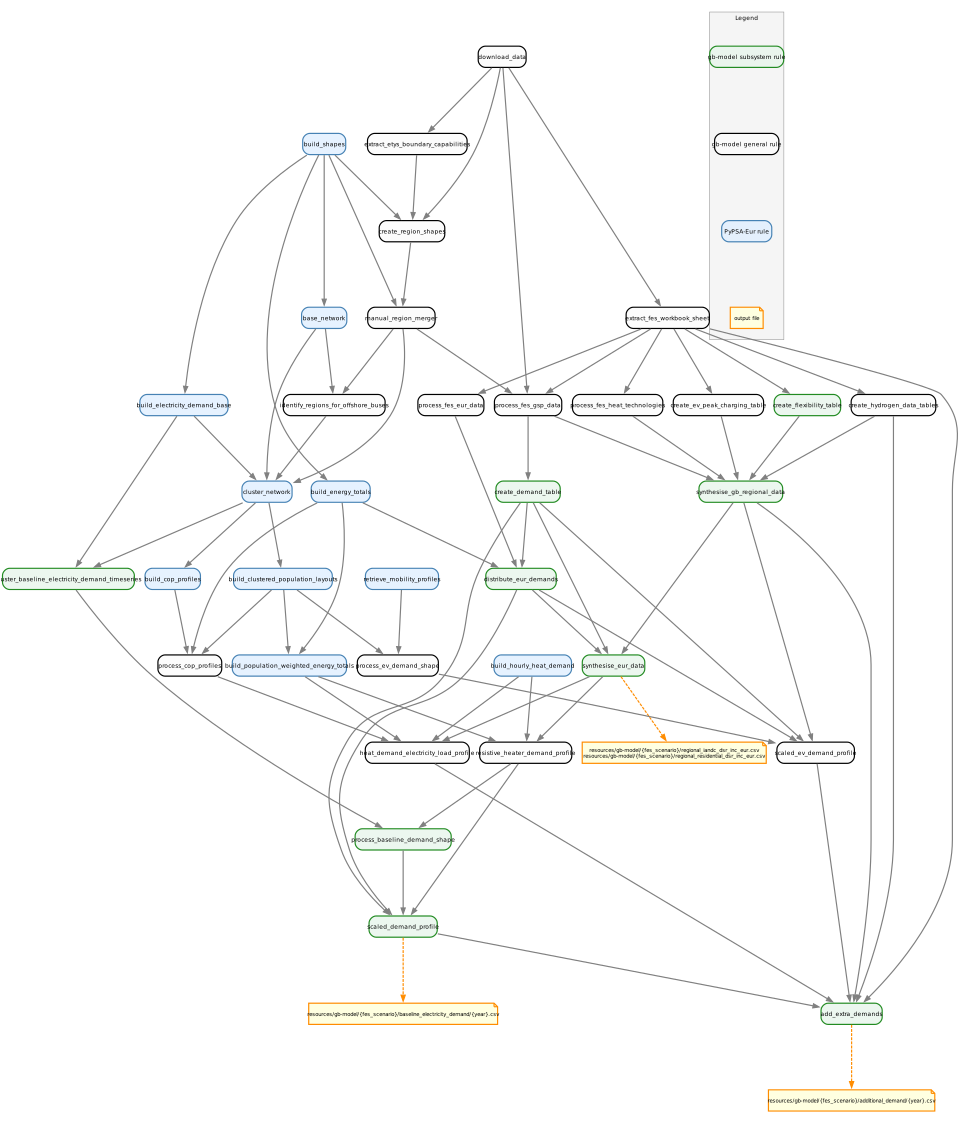
The demand and DSR workflow is implemented through Snakemake rules in rules/gb-model/demand_and_dsr.smk and Python scripts in the folder scripts/gb_model/demand_and_dsr.
The rulegraph for the demand and DSR workflow is illustrated below:
Note
The graph above was generated using:
pixi run filtered_rulegraph \
"resources/GB/gb-model/HT/baseline_electricity_demand/2030.csv \
resources/GB/gb-model/HT/additional_demand/2030.csv \
resources/GB/gb-model/HT/regional_iandc_dsr_inc_eur.csv \
resources/GB/gb-model/HT/regional_residential_dsr_inc_eur.csv \
-w fes_scenario -w year \
-f rules/gb-model/demand_and_dsr.smk \
-s 10,12" \
"doc/gb-model/img/demand_and_dsr_workflow.svg"
The filtered_rulegraph task allows us to trim the full DAG to demand and DSR rules only.
The demand and DSR workflow was built based on several key processing steps as follows:
create_demand_table: Extracts annual demand data from FES workbook indexed by scenario, GSP and year.
cluster_baseline_electricity_demand_timeseries: Clusters PyPSA-Eur baseline electricity demand to the gb-model bus layout, producing a historic baseline electricity demand profile for each bus in GB and rest of Europe.
process_baseline_demand_shape: Removes future resistive heating demand from historical baseline electricity demand to get the net electrified heat demand and then normalizes the resulting demand profiles for each bus.
create_flexibility_table: Extracts DSR capacity from FES data, converts to MW and outputs flexibility tables for each flexibility type.
synthesise_gb_regional_data: Clusters demand and DSR capacity from GSP to network bus level for GB.
distribute_eur_demands: Allocates European neighbour annual demand totals across the model. Uses energy totals and regional FES demand data to create consistent demand inputs.
synthesise_eur_data: Synthesizes demand and DSR data for European neighbours using GB data as a reference, scaling based on relative annual demand totals and applying time zone shifts for DSR operation windows.
scaled_demand_profile: Scales normalized demand profile shapes to match annual regional demand totals
add_extra_demands: Adds additional demand from FES workbook not accounted for in the BB1 sheet (e.g., direct transmission demand, T&D losses) to the model inputs.
Key Assumptions#
DSR links operate at 100% efficiency (no losses in shifting energy).
DSR links and stores do not have any capital or operational costs associated with them, as the model focuses on the technical potential of DSR rather than economic optimization.
DSR balances on a daily cycle. That is, it is not possible to shift demand by more than 24 hours.
The baseline electricity profile shape is the same in all future years as in the historical weather year (2013).
Direct transmission demands do not vary in time.
T&D losses follow the baseline electricity demand profile shape.
Electrification of end-use energy consumption in European countries occurs at the same rate as in GB.
See also
Related Documentation:
Heat System - Heat demand details
Hydrogen Subsystem - Hydrogen demand details
Electric Vehicle Subsystem - EV demand details
Data Sources - FES and other data sources
Configuration - Full configuration reference