
Generation Components#
This page describes how generation assets are represented in the model, including their data sources, capacity assignment, cost parameterisation, availability modelling, and implementation.
Overview#
The generation system covers all electricity-producing assets connected to the modelled network, spanning both Great Britain and the surrounding European countries. Generators are split into broad groups:
Conventional generators: Thermal and nuclear plants (CCGT, OCGT, reciprocating engines, coal, nuclear, oil, waste, biomass, geothermal) that can be dispatched by the model within physical and contractual limits
Renewable generators: Solar, onshore wind, and offshore wind, whose output is constrained by weather-derived capacity-factor time series
Hydrogen-to-electricity generators: Fuel cells and hydrogen turbines — documented in Hydrogen Subsystem
A subset of conventional generators with heat-driven cogeneration duties are subject to different operating costs and efficiencies, and simplified combined heat and power (CHP) constraints that enforce minimum loading when heat demand is present. Another subset of conventional generators with carbon capture and storage (CCS) capabilities are also subject to different operating costs.
All generators are modelled as fixed-capacity, non-extendable assets — the model dispatches within the capacities supplied and cannot invest in new plant.
Data Sources#
The figure below gives a high-level view of the generator data pipeline:
![digraph {
rankdir=LR;
node [shape=box, style=filled];
fes [label="FES BB1/ES1\n(future caps)", fillcolor="#B3D9FF"];
dukes [label="DUKES 5.11\n(existing caps)", fillcolor="#B3D9FF"];
entsoe [label="ENTSO-E\n(outage data)", fillcolor="#B3D9FF"];
costs [label="FES AS.1/AS.7\n+ PyPSA tech-data\n(costs)", fillcolor="#B3D9FF"];
lcr [label="Low Carbon\nContracts", fillcolor="#B3D9FF"];
ppl [label="Powerplants\ntable", fillcolor="#FFFACD"];
avail [label="Monthly availability\nfractions", fillcolor="#FFFACD"];
enrich [label="Enriched powerplants\n(+ costs)", fillcolor="#FFFACD"];
network [label="PyPSA Network\n(Generators / Stores)", fillcolor="#90EE90", shape=ellipse];
fes -> ppl;
dukes -> ppl;
lcr -> ppl;
ppl -> enrich;
costs -> enrich;
enrich -> network;
entsoe -> avail -> network;
}](../_images/graphviz-5dd47df7b7adf17fabc227642c80c6dda82722d4.png)
FES BB1/ES1 — Future Capacity Projections#
The primary source of future generator capacities for Great Britain is the NESO Future Energy Scenarios (FES) 2024 workbook, sheets BB1 (Building Blocks) and ES1 (Electricity supply data).
BB1 provides annual capacity projections disaggregated to Grid Supply Points (GSPs) for each FES scenario. ES1 provides annual capacity projections for a greater disaggregation of technologies than given in BB1, also for each FES scenario.
The link between ES1 technologies and BB1 building blocks is configured in fes.gb.building_block_mapping.
The link between ES1 technologies and PyPSA network carrier names is configured in fes.gb.carrier_mapping.
DUKES 5.11 — Existing Infrastructure#
The Digest of UK Energy Statistics (DUKES) table 5.11 provides a snapshot of current (2023) installed capacities for major power producers in Great Britain. It is used to:
Anchor the spatial distribution of generators where FES does not provide GSP-level data, only Transmission Operator (TO) level data.
Provide current-year capacity baselines that are blended with FES future projections for the distribution step
Carrier assignment from DUKES uses the dukes-5.11.carrier_mapping and dukes-5.11.set_mapping configuration sections.
ENTSO-E Transparency Platform — Outage Data#
Historical generation unit unavailability data is retrieved from the ENTSO-E Transparency Platform (document type A77, “Unavailability of Generation Units”) via its public API.
Data covers Great Britain over the period configured by entsoe_unavailability.start_date / entsoe_unavailability.end_date (default 2020–2024).
Note
API access requires an ENTSO_E_API_KEY set in your .env file or shell environment.
Register at https://transparency.entsoe.eu/ to obtain a key.
FES Costing Workbook — Cost Data#
Running costs (fuel and variable O&M) for GB generators are drawn from the FES costing workbook:
AS.1 (Power Generation costs): Variable O&M (VOM) and fuel costs per technology and year
AS.7 (Carbon Cost): CO₂ price trajectory used to compute marginal carbon costs
These data are combined with capital/fixed-cost parameters from PyPSA technology-data (costs at the configured planning horizon year, default 2035).
PyPSA-Eur Powerplant Database#
For European countries (outside GB), conventional generator capacities are sourced from the PyPSA-Eur powerplant matching pipeline, supplemented with FES European supply data (fes.eur.carrier_mapping).
Low Carbon Contracts Register#
The Low Carbon Contracts Company (LCCC) register of active Contracts for Difference (CfD) is used to identify additional renewable generator capacities (offshore wind, onshore wind, solar, biomass, waste) that may not yet be reflected in the FES or DUKES data.
System Components#
Conventional Generators#
PyPSA Component: Generator attached to the regional AC bus
Conventional generators include all thermal plant that can be freely dispatched up to their installed capacity.
The carriers modelled are:
Carrier |
Set options |
Description |
|---|---|---|
|
PP/CHP/CCS |
Combined-cycle gas turbine |
|
PP/CHP |
Open-cycle gas turbine |
|
PP |
Gas reciprocating engine |
|
PP |
Nuclear (baseload) |
|
PP |
Coal plant |
|
PP |
Oil-fired plant |
|
PP/CHP |
Waste incineration |
|
PP/CHP/CCS |
Biomass/bioenergy |
|
PP |
Geothermal (minor capacity) |
Component names are the carrier names appended with their set name if it is not PP.
That is, gas CHP plants will be named CCGT-CHP; gas CCS plants CCGT-CCS; standard gas plants CCGT.
Renewable Generators#
PyPSA Component: Generator with a time-varying p_max_pu profile
Renewable generators are capacity-constrained to an hourly capacity-factor time series derived from the atlite cutout and ERA5/SARAH reanalysis data via the standard PyPSA-Eur pipeline.
The renewable carriers are:
Carrier |
Notes |
|---|---|
|
Utility-scale and rooftop PV |
|
Onshore wind |
|
Offshore wind (DC-connected) |
|
Run-of-River hydro (no storage reservoir) |
Combined Heat and Power (CHP)#
PyPSA Component: Generator with a time-varying p_min_pu profile
Many conventional carriers (CCGT, biomass, waste, etc.) exist in two variants: pure power plants and CHP units.
FES BB1 reports some technologies (e.g. “Biomass & Energy Crops (including CHP)”, “Waste Incineration (including CHP)”, “Non-renewable CHP”) as including cogeneration.
FES ES1 reports the share of the CHP units and pure powerplants for each year for some of these technologies.
Based on the SubType of the technologies in ES1, which contain CHP as part of the naming, the mapping for the powerplants as CHP or PP is determined.
The resulting set column in the powerplants table therefore determines which fraction of each carrier is subject to CHP constraints — not the carrier itself.
From config/config.gb.2024.yaml:
      set_mapping:
        SubType:
          "^CCS .+": CCS
          ".+ CHP$": CHP
        Technology:
          Storage: Store
Rather than implementing full sector-coupling, the model applies a simplified minimum loading constraint based on local heat demand to the CHP subset.
The p_min_pu profile for each CHP generator is derived from the normalised hourly heat demand of the model region it serves:
where:
\(\hat{q}(t)\) — normalised heat demand (fraction of annual peak) at time t
\(c_b\) — heat-to-power ratio (
chp.heat_to_power_ratio, default 1.5)\(p_\text{min}\) — minimum operation level when running (
chp.min_operation_level, default 0.3)\(\delta_\text{shutdown}\) — heat demand threshold below which the CHP may shut down completely (
chp.shutdown_threshold, default 0.1)
Heat demand \(\hat{q}(t)\) is computed by summing all four sectoral components—residential space, residential water, services space, services water—from the PyPSA-Eur hourly_heat_demand_total_base_s_clustered.nc dataset, then normalising by the annual peak.
This ensures CHPs run at least enough to cover heat demand, without modelling a separate heat bus.
CHP constraints can be disabled entirely via chp.enable: false, in which case the plants are treated as unconstrained conventional generators.
Availability Modelling#
Monthly availability fractions are computed for GB thermal generators using ENTSO-E outage data. The pipeline:
Retrieves planned and forced outage records from the ENTSO-E API by time period (chunked to stay within API rate limits)
Filters outages that exceed
entsoe_unavailability.max_unavailable_days(default 366 days), treating very long outages as effectively retired plant rather than temporary unavailabilityAccumulates unavailable MW on a 1-minute resolution time series for each carrier, then takes the monthly mean
Calculates availability fractions as:
where \(C_\text{total}\) is the total installed capacity for a carrier (from DUKES) and \(\overline{U}_m\) is the mean unavailable capacity in month m.
The resulting monthly profile is applied uniformly across all generators of the same carrier for the simulated year, scaling their effective p_nom.
This is also applied to European neighbouring countries by default unless explicitly de-selected (entsoe_unavailability.extend_to_eur_regions).
Cost Assignment#
Each generator in the powerplants table is enriched with cost and technical parameters through a multi-source lookup:
FES AS.1: Provides year-specific fuel costs and VOM for GB-relevant technologies; averaged across scenarios because scenario names change between FES editions
FES AS.7: Provides year-specific carbon price (£/tCO₂); averaged across scenarios
PyPSA technology-data: Provides efficiency and CO₂ intensity (tCO₂/kWh) for technologies, since this data is absent from the FES workbooks.
Default characteristics: Fallbacks defined in
fes_costs.pypsa_eur_tech_data_defaultsensure all PyPSA-Eur technology data exist even when data is missing.
Marginal costs are assembled as:
where \(\eta\) is efficiency, \(c_\text{fuel}\) thermal price, \(c_\text{VOM}\) variable O&M, \(c_\text{CO2}\) carbon price, and \(I_\text{CO2}\) the CO₂ intensity.
Configuration#
The below configuration snippets are based on the content of config/config.gb.2024.yaml.
Carrier and Set Definitions#
The carriers included in the model and how they are treated (conventional vs renewable, generator vs store) are controlled by:
electricity:
  voltages: [132, 220., 275., 300., 330., 380., 400., 500., 750.]
  base_network: osm
  powerplants_filter: (DateOut >= 2020 or DateOut != DateOut) and not (Country == 'Germany' and Fueltype == 'Nuclear')
  extendable_carriers:
    Generator: []
    Store: []
  conventional_carriers: [nuclear, oil, OCGT, CCGT, engine, coal, waste, geothermal, biomass]
  renewable_carriers: [solar, onwind, offwind-dc, hydro]
FES technology to PyPSA network carrier mapping (GB):
fes.gb:
    generators_and_storage:
      carrier_mapping:
        SubType:
          Battery: battery
          Biomass CHP: biomass
          Biomass: biomass
          CCGT: CCGT
          CCS Biomass: biomass
          CCS Gas: CCGT
          Coal: coal
          Compressed Air: compressed-air
          Diesel: oil
          Fuel Oil: oil
          Gas CHP: CCGT
          Gas Reciprocating Engines: engine
          Hydro: ror
          Hydrogen CHP: hydrogen-turbine
          Hydrogen: hydrogen-turbine
          Liquid Air: liquid-air
          Marine: marine
          Nuclear - Large: nuclear
          Nuclear - SMR: nuclear
          OCGT: OCGT
          Offshore Wind: offwind-dc
          Onshore Wind: onwind
          Other Renewables: geothermal
          Pumped Hydro: PHS
          Solar PV: solar
          Waste CHP: waste
          Waste: waste
      # [doc:fes-gb-set-mapping-start]
      set_mapping:
        SubType:
          "^CCS .+": CCS
          ".+ CHP$": CHP
        Technology:
          Storage: Store
      # [doc:fes-gb-set-mapping-end]
      building_block_mapping:
        Gen_BB001: [Gas CHP, CCGT, CCS Gas]
        Gen_BB002: [Gas CHP]
        Gen_BB003: [Gas CHP]
        Gen_BB004: [Other Renewables]
        Gen_BB005: [Diesel, Fuel Oil]
        Gen_BB006: [Gas Reciprocating Engines]
        Gen_BB007: [] # Hydrogen fuel cells
        Gen_BB008: [OCGT]
        Gen_BB009: [CCGT, CCS Gas]
        Gen_BB010: [Biomass, CCS Biomass, Biomass CHP]
        Gen_BB011: [Waste, Waste CHP]
        Gen_BB012: [Solar PV]
        Gen_BB013: [Solar PV]
        Gen_BB014: [Offshore Wind]
        Gen_BB015: [Onshore Wind]
        Gen_BB016: [Onshore Wind]
        Gen_BB017: [Marine]
        Gen_BB018: [Hydro]
        Gen_BB019: [Other Renewables]
        Gen_BB020: [Nuclear - Large, Nuclear - SMR]
        Gen_BB021: [Coal]
        Gen_BB022: [] # interconnectors
        Gen_BB023: [Hydrogen, Hydrogen CHP]
        Gen_BB024: [Offshore Wind]
        Srg_BB001: [Battery]
        Srg_BB002: [Battery]
        Srg_BB003: [Pumped Hydro]
        Srg_BB004: [Liquid Air, Compressed Air]
      building_block_mapping_tolerance: 0.005
FES technology to PyPSA network carrier mapping (EUR):
fes.eur:
    generators_and_storage:
      carrier_mapping:
        SubType:
          Battery: battery
          Biomass CCS: biomass
          Biomass: biomass
          CCGT CHP: CCGT
          Coal: coal
          Fossil Gas: CCGT
          Fossil Oil: oil
          Geothermal: geothermal
          GT Hydrogen: hydrogen-turbine
          Marine: marine
          Nuclear: nuclear
          Pumped Hydro: PHS
          Run-of-river Hydro: ror
          Solar PV: solar
          Waste: waste
          Wind Offshore: offwind-dc
          Wind Onshore: onwind
      set_mapping:
        SubType:
          ".+ CCS$": CCS
          ".+ CHP$": CHP
        Category:
          Storage: Store
Note
We use the dot notation for parent configuration keys.
For example, fes.gb is equivalent to fes as the top-level key, gb as the first-level key, then the configuration snippet is at the level below this.
CHP Constraints#
chp:
  enable: true  # Enable simplified CHP constraints
  heat_to_power_ratio: 1.5  # Heat-to-power ratio (c_b coefficient) - typical for gas CHPs
  min_operation_level: 0.3  # Minimum operation level when running (30% of capacity)
  shutdown_threshold: 0.1  # Heat demand threshold below which CHPs can shut down completely (fraction of peak demand)
Implementation Notes#
Data Processing Workflow#
The generator system is built through a pipeline implemented in rules/gb-model/generators.smk:
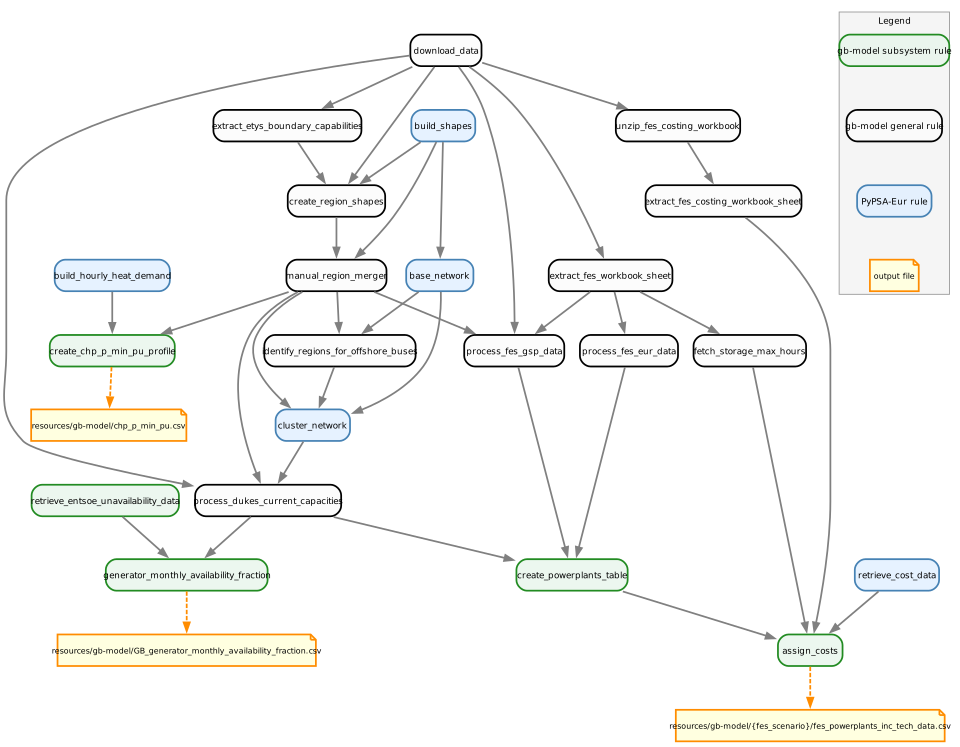
Note
The graph above was generated using:
pixi run filtered_rulegraph \
"resources/GB/gb-model/HT/fes_powerplants_inc_tech_data.csv \
resources/GB/gb-model/GB_generator_monthly_availability_fraction.csv \
resources/GB/gb-model/chp_p_min_pu.csv \
-w fes_scenario -w year \
-f rules/gb-model/generators.smk \
-s 10,8" \
"doc/gb-model/img/generators_workflow.svg"
The filtered_rulegraph task allows us to trim the full DAG to generator-related rules only.
Retrieve outage data (
retrieve_entsoe_unavailability_data): Fetches ENTSO-E unavailability records for GB over the configured date range, chunked to respect API limitsMonthly availability fractions (
generator_monthly_availability_fraction): Combines outage records with DUKES capacity baselines to produce per-carrier, per-month availability fractionsPowerplants table (
create_powerplants_table): Assembles GSP-level capacity table from FES BB1 (future), DUKES (existing), and European supply data; handles both direct GSP-level data and distribution from Transmission Owner (TO) regional totalsCost assignment (
assign_costs): Enriches the powerplants table with operating costs and technical parameters.CHP minimum operation profile (
create_chp_p_min_pu_profile): Derives the hourlyp_min_putime series for CHP generators from the aggregated heat demand dataset
Network Assembly via PyPSA-Eur Methods:
The artefacts produced by generators.smk are consumed by the compose_network rule (rules/gb-model.smk), which assembles the final PyPSA network.
In addition to the generator-specific outputs above, compose_network also receives several standard PyPSA-Eur inputs:
Renewable capacity-factor profiles (
profile_{tech}_clustered.nc): Hourlyp_max_putime series for solar, onshore wind, offshore wind, and hydro, produced by the atlite cutout pipeline from ERA5/SARAH reanalysis data.Technology costs CSV (
costs_{year}.csv): The PyPSA technology-data cost table for the planning horizon year, used here only because we have to pass it through to standard PyPSA-Eur methods when attaching some generators.
Rather than reimplementing generator attachment logic, compose_network calls PyPSA-Eur’s standard functions from scripts/add_electricity.py directly:
attach_conventional_generators— adds thermal and nuclearGeneratorcomponents from the enriched powerplants tableattach_hydro— adds hydroGeneratorandStorageUnitcomponents (including PHS) using the capacity-factor profiles and hydro capacities fileattach_wind_and_solar(local wrapper) — adds renewableGeneratorcomponents with time-varyingp_max_pufrom the clustered profiles
This reuse of upstream PyPSA-Eur methods ensures that the GB model stays consistent with the broader PyPSA-Eur network representation while layering GB-specific capacity data, costs, and availability fractions on top.
Capacity Distribution:
When FES supplies only TO-level (Transmission Owner region) totals rather than GSP-level data, capacities are distributed to GSPs using a four-step hierarchy:
GSP-level FES data for the same carrier and year
GSP-level DUKES data for the same carrier
GSP-level FES + DUKES data for all carriers combined
Overall national distribution as a fallback
This hierarchy preserves known regional concentrations (e.g., offshore wind clusters near specific GSPs) while gracefully handling carriers with no fine-grained spatial data.
Key Assumptions#
No capacity expansion: All generator capacities are fixed at the FES scenario projections for the modelled year; the optimiser dispatches within these limits
Uniform availability: Monthly availability fractions are applied uniformly to all generators of the same carrier across all GB regions
CHP heat coupling: CHPs are constrained to run above a heat-demand-derived floor but are not connected to a separate heat bus; heat demand is satisfied exogenously
Cost averaging: FES fuel and VOM costs are averaged across scenarios due to naming changes between FES editions; this has a small effect (≤ ~10% for battery VOM) on marginal costs
Infinite fuel supply: Fuel feedstocks (gas, coal, oil, biomass, etc.) are assumed to be available in unlimited quantities at the modelled marginal cost; no supply constraints or fuel capacity limits are enforced
European generators: European countries use the PyPSA-Eur conventional generator database; availability fractions are applied outside GB by default (disable via
entsoe_unavailability.extend_to_eur_regions), but CHP constraints are not applied outside GB
See also
Related Documentation:
Hydrogen to Electricity Conversion - Hydrogen-to-electricity generators (fuel cells and turbines)
Dispatch and Redispatch Modelling - How generators are dispatched in the optimisation
Configuration - Full configuration reference
External Resources:
FES 2024 Data Workbook - Primary capacity data source
DUKES 5.11 - Existing installed capacity
ENTSO-E Transparency Platform - Outage data API
PyPSA technology-data - Technology costs and parameters
Low Carbon Contracts Company - CfD generation register